
Water System Essentials That Travel Well: The Filters, Jugs, Adapters (and Checklist) We Actually Use
If you travel by boat or RV long enough, you’ll eventually hook up to a sketchy water source.
Shady marina hose bib in the corner of the dock? Check. Dusty campground spigot next to the dumpster? Also check.
Clean water is one of those “invisible” systems that only gets your attention when something tastes off, turns brown, or wrecks your plumbing. On our 74’ Hatteras Empire and our rigs on land, we treat water like fuel: you don’t just dump anything in the tank and hope for the best.
This is the gear that’s earned a permanent spot on board and in the truck, plus the exact checklist we run before we take on any questionable dock or campground water.
Why We Don’t Trust Any Dock or Campground Water
Even at “nice” marinas and campgrounds, water can be:
- Over-chlorinated and nasty-tasting
- Full of sediment that clogs filters and fixtures
- Questionably sanitized (old plumbing, low use, cross-contamination)
- High in minerals that leave scale in heaters, faucets, and tank sensors
On a boat or in an RV, bad water isn’t just gross—it’s a systems problem. Scale builds up in water heaters. Sediment ruins pumps. Bacteria turns tanks into a science project.
So we build our setup around three goals:
- Make whatever comes out of the tap safer.
- Protect our onboard tanks and plumbing.
- Make the water actually taste good enough to drink.
The Filtration Stack: How We Treat Unknown Water
We like redundancy. Not because it’s trendy, but because repair parts are usually a long dinghy ride or a long drive away.
Here’s the basic stack we run when filling tanks from any unknown source (dock or campground).
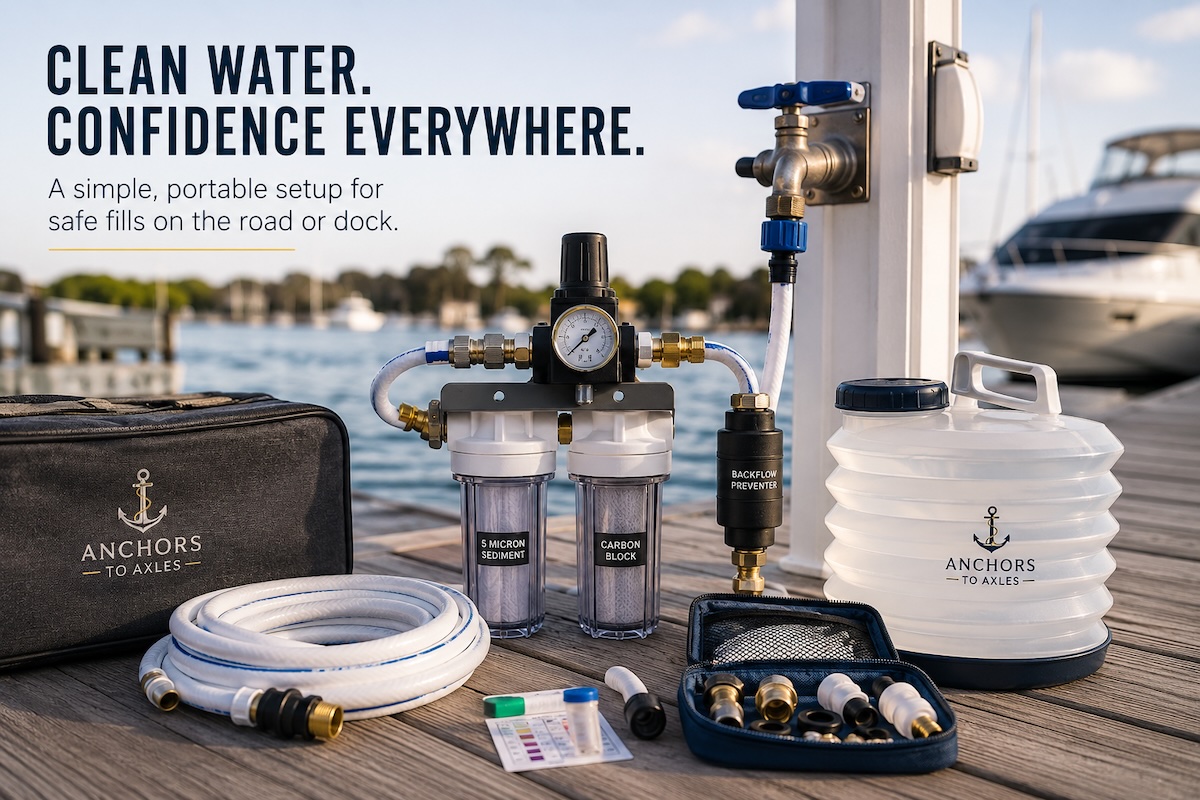
1. Pre-Filter at the Spigot (Sediment Workhorse)
This is the first line of defense and the piece people skip most often.
We use:
- A standard 10” canister filter with garden hose fittings
- 5-micron sediment cartridges for everyday use
- 1-micron cartridges when the water is obviously dirty (rusty, sandy, cloudy)
Why it matters:
- Keeps sand, rust, and gunk out of your tank and finer filters
- Saves your onboard pump and fixtures from abrasion
- Extends the life of the nicer carbon filters downstream
On the dock or at camp, our setup usually looks like:
Spigot → Hose → Pressure regulator (if needed) → Canister sediment filter → Hose to boat/RV inlet
2. Carbon Block for Taste, Chlorine, and VOCs
Sediment alone won’t fix “pool water” taste or chemical funk. So we follow it with a carbon block filter—either:
- A second 10” canister plumbed after the sediment filter, or
- An inline RV-style carbon filter if we’re traveling light
What carbon blocks do well:
- Strip out chlorine and improve taste
- Reduce many organic compounds and some industrial nasties
- Make water more drinkable even if it’s technically already “safe”
On the Hatteras, we run dual canisters on the dock line when we can: first sediment, then carbon. In the truck camper / tow rig, we usually run a sediment canister at the spigot and a quality inline carbon filter at the rig.
3. Final Drinking-Water Filter On Board
This is the “belt-and-suspenders” layer that handles whatever made it past the first two.
Options we like:
- Under-sink carbon block with its own faucet (simple and cheap to maintain)
- Portable gravity filter (Berkey-style or hiking-grade) for filling jugs if we’re really not sure about the source
- For the truly paranoid or immunocompromised: UV sterilizer inline on the cold water to the galley
On Empire, we drink from a dedicated filtered tap in the galley. In the RV, we either use that same under-sink setup or pour from gravity filters into collapsible jugs.
Collapsible Jugs: The Unsung Heroes of Sketchy Water Management
Collapsible jugs are boring until you really need them. Then they’re all you think about.
We carry:
- Two to four 5–7 gallon collapsible jugs
- A couple of 1–2 gallon soft bottles for quick trips and dinghy runs
Why collapsible beats hard-shell for us:
- Easy to stash in lockers or truck boxes when empty
- Light enough to carry down a dock or from a distant spigot
- Great for “quarantine” water that you don’t quite trust in your main tank
- Perfect for mixing: fill jugs from a better source and top off the main tank later
How we actually use them:
- Buffer tank: Fill jugs first, then pump through filters into the main tank so we’re never tied up at a busy dock or shared spigot.
- Separate drinking supply: If we don’t trust the campground plumbing, we’ll run our best filtration into jugs and use that only for drinking and cooking.
- Dinghy runs: At marinas with terrible dock water but decent shore facilities, we’ll haul jugs in the dinghy, filter aboard, then fill the main tanks.
Fill Adapters That Save the Day (and Your Sanity)
If you’ve ever tried to hold a loose hose inside a fill port while the pressure surges and blasts you in the face, you already understand why good adapters matter.
We keep a small “hydration tool kit” that lives in a labeled bag:
- Hose-to-hose adapters: Male-to-male and female-to-female. These fix at least 50% of the “this won’t connect” problems.
- 90° fill adapter: Great for RV side fills and deck fills on boats to reduce strain and water blow-back.
- Assorted quick-connect fittings: For swapping between different hoses and filters fast.
- Extra hose washers and screens: These stop leaks and catch big debris before it hits your filter.
- “Water thief” rubber adapter: Lets you hook a hose to non-threaded faucets in a pinch (bath houses, random public spigots). Not forever-gear, but a nice emergency option.
- Pressure regulator: Especially on the RV side, campground pressure can be wild. We protect our plumbing and filters with an adjustable regulator when hooking up direct.
On the boat, dock water usually goes through our filter stack and then into the tanks—not directly into the ship’s system—unless the marina water quality is known and trusted.
Our Pre-Fill Checklist for Sketchy Dock or Campground Water
This is the mental (and sometimes written) checklist we run before committing anything to our tanks.
-
Look at the spigot and hose.
- Is it crusty, green, or obviously leaking?
-
Is the hose labeled “potable” or is it the same one used to rinse fish tables or dump stations?
If the hose looks rough, we use our own.
-
Flush the line.
- Run water for 30–60 seconds before connecting filters or filling jugs.
- Flush until the water runs clear and steady, especially if the faucet looks rarely used.
-
Smell the water.
- Strong chlorine, sulfur, or “swamp” smell are red flags.
- Funky smell = jugs-only mode, then heavy filtration before anything hits the tank.
-
Run through the pre-filter stack.
- Spigot → pressure regulator (if needed) → sediment filter → carbon filter → tank or jugs.
- If we’re tight on time or gear, we at least run sediment + carbon in some form.
-
Tank strategy decision: Fill or just top off?
- If the water is “marginal but usable,” we’ll top off tanks we know have decent water already, not fill from empty.
- If it’s really questionable, we skip tank filling entirely and just make filtered jug water for drinking and cooking.
-
Label and separate.
- Drinking jugs get dedicated use and live away from “utility” containers.
- We don’t mix chemical-use jugs (cleaning, washdown) with drinking water containers—ever.
-
Post-fill sanity check.
- Run the onboard tap after filling and smell/taste a small amount.
- If something seems off, we switch to drinking from jugs and start planning a tank flush at the next good stop.
The Real Win: Confidence in Your Water, Anywhere
The point of all this isn’t to obsess over every drop. It’s to build a simple, repeatable system so that when you pull into a weird little marina or a dusty campground, you don’t have to guess.
With a solid filter stack, a few smart adapters, and some beat-up collapsible jugs, you can:
- Protect your tanks and plumbing
- Make almost any reasonable source usable
- Keep your crew drinking water they actually like
If you want a deeper dive into our exact water setups on Empire and our land rigs—including specific gear, layouts, and what’s actually held up on the road and at the dock—follow along at Anchors to Axles. We’ll keep sharing what works, what breaks, and what we’d buy again after a few thousand miles and a lot of sketchy spigots.