Our 74ft Hatteras, 2.5 Years Later
Today we're gonna take a tour of our 1998 74 foot Hatteras Sport Deck. We've spent the last two and a half years bringing her back up to where she used to be.
Coming Aboard Empire
We are on the aft deck of Empire. It took us two and a half years to finally put our name on the boat. But we're going for the Star Wars themed. As you can see behind me, the letters are in a Star Wars font. And James even added something a little special to the boat. I'll let you talk about
The Imperial March Horn
that James. We added a 24 volt truck horn that plays the Imperial Death March song, which is the And it can be heard for about four or five miles away. So anytime we want to be heard, it's awesome. And actually if you're getting ready to overtake a small fishing boat or whatnot, and they're just not paying attention, it turns out when you play that song right behind them, they move pretty fast. They do. Yes. So let's go aboard. We'll show you the aft cockpit, the salon, and we'll talk about other improvements that we've made to the boat.
The Aft Cockpit
Okay. Here we are in the aft cockpit. This is a great place to hang out during the spring, fall, winter time in Florida. It is enclosed. There is an AC and a heater in the corner. And one of the things that we have upgraded in this is we added a new fridge in this compartment. This used to be really nasty. So we took out the fridge, James painted it, and then we've got a brand new one. It still has a sticker on it. As far as other improvements for this area of the boat, we're thinking about changing out these chairs. They are the chairs that came with the boat. I think they're a little bit tall, and they are very uncomfortable when you're wearing shorts. So we'll change out the chairs. We did think about changing out the table, making it a little bit smaller. For the folks that are a little bit bigger, it's really a pain in the butt to scooch all the way down and go in through this area. So one of the other things that we've discovered is, as you can see right here, our American flag has been quite torn up. Directly behind us, about two miles, is how you leave the port and get in the ocean. So there's a lot of salt water in the air and a lot of breeze. So we're going through American flags about once a year. And I'm a firm believer in that if you are operating in a boat and you're from the U.S. You should have a big giant U.S. flag on the back.
The Salon
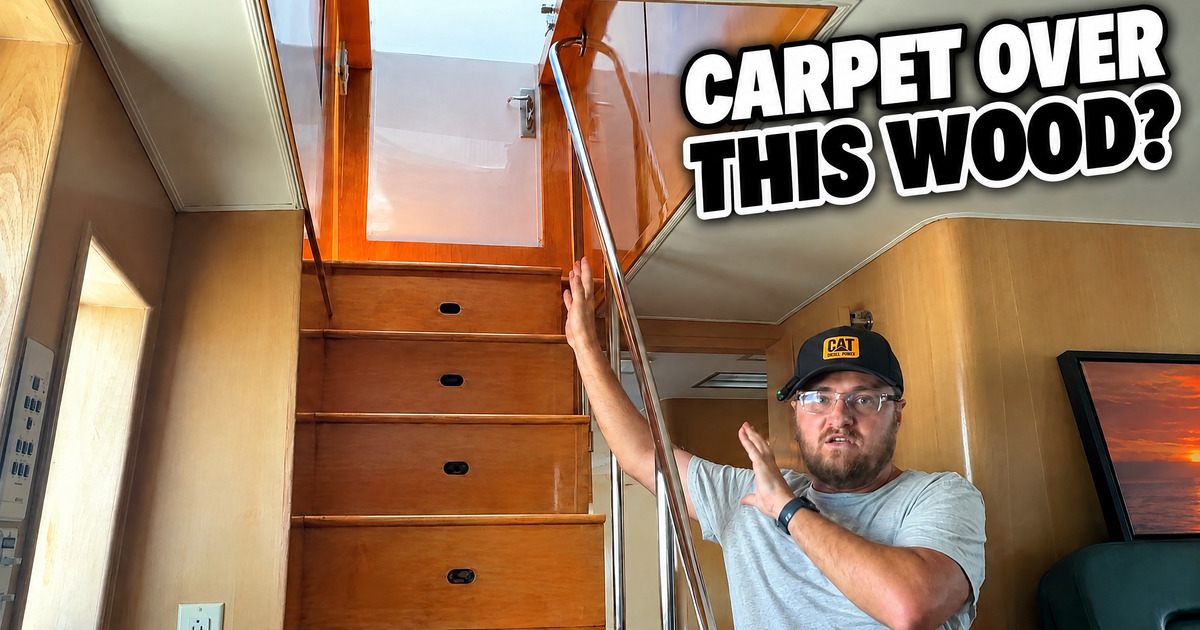
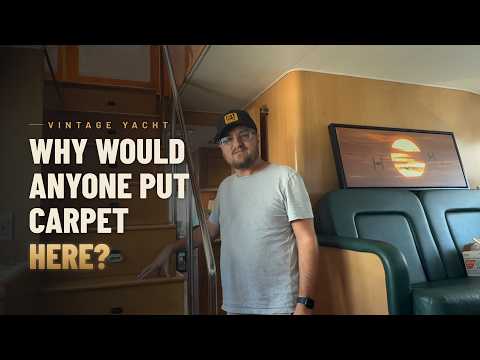
Let's go inside Empire. We have the AC rolling. It's not too warm today, but you always need AC on the boat. So some of the improvements that we've done in the salon, we removed all of the carpet that was in here. James and I spent a couple weekends pulling up carpet. And then we had a really good friend of ours, Zach, that laid the floor down. And right here used to be a ginormous TV cabinet for the big box TVs. James and Zach removed that. So one of our really good friends, Zach, installed the floor for us. And then he also installed this really nice sturdy handrail that and ties in really nicely with the boat. And he tried to match the color with the wood on this boat being almost 30 years old. A lot of it has faded from the sun. So he tied it in as best he could. I think he did a fantastic job. What used to be here was a handrail. And then we had really thick plexiglass on these three sides. And, you know, it looked okay, but I think this looks much nicer and ties everything really well. We have one more thing to complete the stairs. And that will be a piece of wood right here with the Imperial logo and the Rebel logo, one on either side. So we're waiting to find a design that we really like and a material that would go well with the boat. So that is one last project for the stairs. And then some other updates in here is reupholstering the leather couch. I believe that's original with the boat. There's tons of storage in there, which I really like. I mean, you literally can hide a body in here. So we've got it pretty filled up, but we definitely do not want to lose this couch. So I think we're just going to reupholster it and match the color as close as possible. Another project we have starting really soon is we're going to tent the windows to cut down on the UV to let it protect the wood a little bit more and make it cooler in the salon so our ACs aren't working as hard. James had a really lofty goal of when we got this boat was to replace one AC a year. And we've done that. We've done that twice. We've been lucky enough to replace two ACs a year. And one of the replacements actually was here in the salon. Instead of going to one gigantic AC, our installer actually put two smaller ones so that if one does die, we have a backup. And one of the cool things that we have that we haven't used much, but as we live on the boat more is we have a really awesome ice maker in this cabinet. It produces tons of ice. And we just don't use it when we're here because we just don't use a lot of ice right now. And one of the things that Trish was going to talk about next is we're getting ready to put in a brand new TV cabinet. Yeah, so Zach, our friend that did the floors and the banister, he's actually going to custom make us a pop-up TV stand so we can have a TV in it. That's how James and I like to relax after working on the boat at night. We like to turn on Netflix or watch YouTube. So there's going to be a pop-up TV here with some shelves in front so we can store some books and some games that we like to play on the boat as well.
The Galley (Our Worst Project)
Another addition we added was this table for four so that James has somewhere to work. As you can see, he's already set up. He is missing one screen though. For what he does for his profession, he needs... The more screens, the better. Yes, the more screens, the better for James. So right now he has to deal with that. Moving forward to our galley, one of the projects that we had in here other than the floor, this actually was a very extensive demo on the floor. We had glue in vinyl tile and the glue being from almost 30 years ago was still sticky. I guess that is the norm for the industry is you put glue down, it retains its stickiness. So James and I spent three weekends tearing up the floor. I think it had to be one of our worst projects we've done on this boat. For sure. By a mile. So we did it in the middle of summer. We had to have a heat gun pulling up tiles. It was very tedious. But I did find a really good hack with the glue being so sticky after you pull up the tiles. I YouTubed how to get rid of the stickiness because we tried glue gone. We tried adhesive remover. We tried acetone. Nothing would get rid of the stick. But found out baby powder or specifically corn starch. If you use corn starch, I say baby powder because it smells good. You know, I sprinkled it on, swept it around. All the stickiness was gone and then our boat smelled amazing because it smelled like baby powder. So that that was the big project for the galley. The other one is is we replaced the backsplash. It used to be a really nasty. I can't say nasty. It was a light yellow color. We didn't care for. So we replaced this. Our next project will be to replace the cooktop with an induction. I would like to do induction. I don't know if James will allow me. But updating the microwave and the cooktop. And I think that will be it for our galley other than some lighting. So, you know, and we got a full sink here and a dishwasher, which is really awesome. And it actually works. And one of the greatest features is it has a full size refrigerator with a water connection. So if you need to fill up a water bottle or whatnot, you can do it. This came with a boat and is probably going away. But it's kind of funny. Oh, it's not going away. We're leaving both of those. Going forward into the helm room, we pass the pantry, which this is really nice. It's nice to have a pantry. And then something that's not so fun is the AC for the galley. One of them is actually behind the pantry. So you have to pull all this out to get to the AC unit. It's not the AC. It's the handler in it. Yeah, that's right. Yeah. So nice size pantry. And then going forward to the helm.
The Pilothouse
This is one of my favorite areas of the boat. This is our pilot house. So if the weather's bad, it's super hot out, or for whatever reason, you don't want to drive from outside. You can very comfortably drive from inside here. Or if you're doing an overnight passage or something like that, where you would just want to be inside, you can. We have a flybridge also that has all the same controls, all the same monitors that exist down here. The one downside to having a pilot house is, and a flybridge is every time you upgrade the electronics, you have to do it twice. Given the comfort down here and the options available, we don't mind doing it. Two of our three boats have had a pilot house, and we'll probably keep it that way. Walking further into the pilot house, we have two sets of controls for the main engines. One shifts it into gear, so forward and reverse. Unlike an automobile, we don't have first, second, third, fourth, and fifth gear, whatnot. It's either forward or reverse. That actually makes the transmissions on the Caterpillar 3412s that we have a little bit simpler than, say, a Ram 2500. Once you shift it into gear, these are your actual throttles, so if you want to give it more RPMs to give you more power, you just bump these. I have to admit, when I first got the boat, I was used to electronic throttles, which are pretty much shifted into gear, and then just keep pushing if you want more power. Over time, I've actually grown to love this older system a little bit more than the electronic ones. There's a lot more flexibility once you get good at it. The other thing that's great about it is these are hydraulic controllers. Electronics go wrong frequently. With hydraulic controllers, it's simple. It's old school, simple, and reliable. If we were somewhere where help wasn't available in, say, one of our hydraulic lines blew, that's something that we could do ourselves as long as we had the tubing and the hydraulic fluid, which we do. We have autopilot, Garmin MFD, which controls a lot of our navigation, bow thruster, controllers for our lights. We have four fuel tanks on board and a very large freshwater tank. We also have a water maker. We are getting ready to replace that water maker. That one is original to the boat. The parts per million on it are less than 50, which is, by modern standards, considered good still, but it's just so old that we're replacing it. We've mentioned it in other videos. We're not big anchors, meaning we like to be on a dock. We just sleep better that way. We feel more well rested, and we like being around other people. We are going to replace the water maker, but it's very rarely going to be used in our case, mostly for maintenance. In the times that we do go down in the Bahamas and we want to anchor out for three or four days, water gets used really quickly on a boat. We'll be able to make our own water. This is a Hatteras, really old from the 70s technology, 12-point alarm system. They're connected to the main engines. They're connected to our bilge bumps. It's actually ultra clever. I spent three or four months digging into it, replacing parts and getting it back to 100%. A lot of Hatteras owners actually remove that, not understanding how good it is. Even though it's old and it's not super easy to fix, once you get it working, it's reliable because it's more analog than it is digital. We will have digital information coming into our boat. I'm working on that now through NMEA 2000, which is the network on a boat and how everything talks to it. We'll have analog sensors and digital sensors, which is great for reliability. If you come over here, this is kind of complicated, but once you get used to it, it's not so bad. It's way more complicated than any of our other boats. This is how you manage AC power. Whether it's coming from the generator or shore power, the way that Hatteras built it is actually pretty amazing. It's ultra flexible. It's got all kinds of neat things. If you lose one leg of power on the 50 amp cable at the dock and you only have the other one running, you can configure this nine different ways. When you get underway, we have two generators, which we'll show you. You can control which parts of the boat get powered by which power source, whether it's shore power or generators. That 12 point Hatteras alarm system I was talking to is actually wired into all this. It's actually smarter than one would think. If you get shady power from shore power, it actually detects it on the old analog Hatteras system and will tell you, "Hey, something's wrong with your power. You need to go look at it." For that reason, I've decided to keep it, even though we're going to go digital with just about everything else. One of the things that Trisha and I are working on right now, I found this on Facebook, in the Hatteras group actually, is we're starting to color code our breakers here. We're going to add a little diagram here that explains how we did it. There's so many breakers between this and the DC breakers. We have a couple of those panels on the boat. When you're switching from generator after being out on a trip or whatnot and coming you can easily forget something like an AC pump, come back the next day and four of your ACs are complaining. We're going to color code those all that way, with a little map here that way anybody that, not just me, but Trisha who doesn't do a lot of this stuff, usually she could do it. Anybody coming on the boat can switch around the power since it's all color coded and know exactly what to turn on, when kind of thing. I think that's it for this room. What are we doing about this right here? Yeah, so this is a original 96 mile Furuno radar. It came with the boat and I'm pretty sure it's original of the boat, which is from nice. I thought about taking it out because we added a Garmin radar, which connects to our Garmin MFD. This actually works super well. It's a green screen, which is ancient screens, but a couple of people I talked to said Furuno is such a good radar. That is such a great radar to keep it. So even though it's green and you've got to tune a lot of stuff that the newer radars will just do for you, if you're in really bad weather, we have two radars so we can kind of rely on both. Will that be on the boat forever? I don't really know, but we're going to keep it until it either stops working or we decide
Navy Sonar Techs & the Old Radar
James and I were in the Navy together and we were both Sonar Tech. So this green screen actually reminds us of our Navy time when we would do deployments. We're both very familiar with it, looking at it. We know how to read it and it's kind of one of those. I don't know. Well, I'm going to sound old, even though I don't think I am, but after spending hundreds of hours in the military, I actually think that you can see more information and more data more easily on just the green display than you can the Garmin color display. I appreciate that most people aren't going to feel the same way, but I really like it. So we're going to keep it for the time being. And if we walk over here, there are stairs
The Flybridge Stairs
going up to the flybridge that our friend Zach also refinished for us. It used to have carpet on it and now they just kind of tied the boat in together. But we do have some non-skid, non-slip adhesive on them so you won't fall down. And any broker or anybody that knows these boats will tell you that this is an area that usually looks like crap after 30 years. And just because it's so exposed, there's two doors right there, water gets in, people always take care of that stuff. So our boat was kind of in the same state. It really looked bad up there and now it looks awesome. So that should last for another long time. And now we're going to go. Well, we do have one more project that we're working on down here is replacing the window screens. So when we were watching YouTube, we found this company called Gone With The Winds. We were watching their channel. Gone With The Winds. We saw that they had recently gotten new window screens that were magnetic. So magnetic, MagnaShield, MagnaScreen, that is their name, is coming out to the boat to laser map them and we're going to replace the old style window screen with magnetic shades. I'm pretty excited about that. Yeah, and they offer a lot more protection. And every single window in this room will have its own independent protection, which as Trisha keeps talking about it, a boat that's sitting in 90 degree water is going to be hot. The ACs are going to have to work hard. So this will block a lot of the UV light and block a lot of the heat from coming into the boat. We don't want to tent the windows in here because at night, which, but even though we hate night or boating at night, you will end up having that happen at some point, just the way things work. So we thought by tending these windows in here, it would actually reduce the visibility at night. We don't want that. So the really cool thing with the magnetic ones is you can actually just pull them off real easily. They, they stick really well and we're going to give a shot. We're going to keep the original one just in case we don't like them, but we think it's going to be great. So now, Trisha, where are we going next? We're going to go up to the flybridge.
The Flybridge
Okay. All right. We are on the flybridge and it's a great space. This is where we tend to congregate when we're underway. Nice breeze, beautiful views, two helm seats. James has a new MFD up here. So this is where he controls the boat mainly when we're underway, honestly. Ample seating behind us. We haven't done a whole lot with the flybridge. We haven't needed to, honestly. The upholstery was redone when we bought the boat, luckily for us. The only thing that we have done is replace the fridge upstairs. And this is the same one that we put downstairs too? It is, yes. So James took that out, took the old fridge out and painted in there to make it look nice and bright. And you know, that way you can tell if it gets dirty, it's really easily clean. So that was the one project that we did up here. I think going forward, we do have to replace the seat covers up here because they are tattered and torn. So we do need to replace the seat covers and then we also need to replace the sink faucet. So those are two small, one somewhat big, one small project up here. We feel like we're getting down to a lot of small projects now. Yeah, yeah. After two and a half years, I would definitely agree with you on that.
The Bow
All right, here we are on the bow. This is actually one of my favorite spots of the boat when we're coming in for the day after leaving the ocean. We've got two great bow lockers here where we can store clean stuff. They make great seats. We also have seating and a sun lounger pad. Those actually need to be redone. But for the most part, one of our future projects, and James does have it on order, is we're replacing our anchor and our anchor chain because it does, she looks a little tired. I really think she can need some help. So we've got that on order. But we do have a windlass with up and down controls. We do have a connection for a secondary anchor if we need it and then freshwater wash down with the standard Hatteras connection. Yeah, so I think this is actually often a misunderstood function of a boat. And to be honest with you, until I looked at it and heard a couple other people talking about it, I didn't really understand what it was for when I first bought it, but that's exactly what Trisha said. If you ever need to throw a second anchor out, you would do it there.
The V-Berth & Hidden Generator Access
Welcome to the V-berth. This is one of four state rooms that we have on the boat. We have a full hanging locker behind James and we just had the carpet redone in this room so she smells really good. We have this really nice size hatch, which we actually keep it closed so it keeps it a little bit cooler in here. This room has got great lighting in it and honestly, this is a really nice room. We've had couples stay on board and they say the mattress is comfortable. We also have access to the generator in this room as well and they have their own attached bathroom. We use it as the day head, but there's two doors. Day head and it's also
The Captain's Room
their private. Behind me is the bunk room or as it says on the door, the captain's room, captain's state room. As owner operators, we actually use this as storage or if we had a single person, they could sleep in here or this is actually a great kids room, but it also has its own attached head with showers. And natural lighting. Yes, it has. That's one thing I like about Hatteras, how they put the hatches in the bathrooms. I did see in a recent video just the other day, actually, somebody that had one of these Hatteras Sport Decks like ours actually remove these bunks and turned it into an office. It's a pretty awesome space for an office. And as Trish said, because we are owner operators, we'll most likely never have a captain and crew on board. It's in the back of my mind to turn that into an office. It'd be kind of cool.
The Hidden Generator Room
Underneath this hatch is a separate engine room that contains all of our AC units and two 23-kilowatt Onan generators. I'm going to skip showing it in this video, but on another video we can talk, go down in there and see a lot more and talk about it. If people are interested. And here we have the day head or the bow stateroom's head. It has a separate door here where if you're docked or it's late at night or whatever, they can have their own access and shut this door. Here we have a full washer and dryer, which is behind the day head here. Trisha uses it regularly. I'm not looking forward to the day that we have to replace that. And if we keep going, that goes up to the pilot house, of course, where we came from. And down here is the midship state room.
John & Tanya's Stateroom
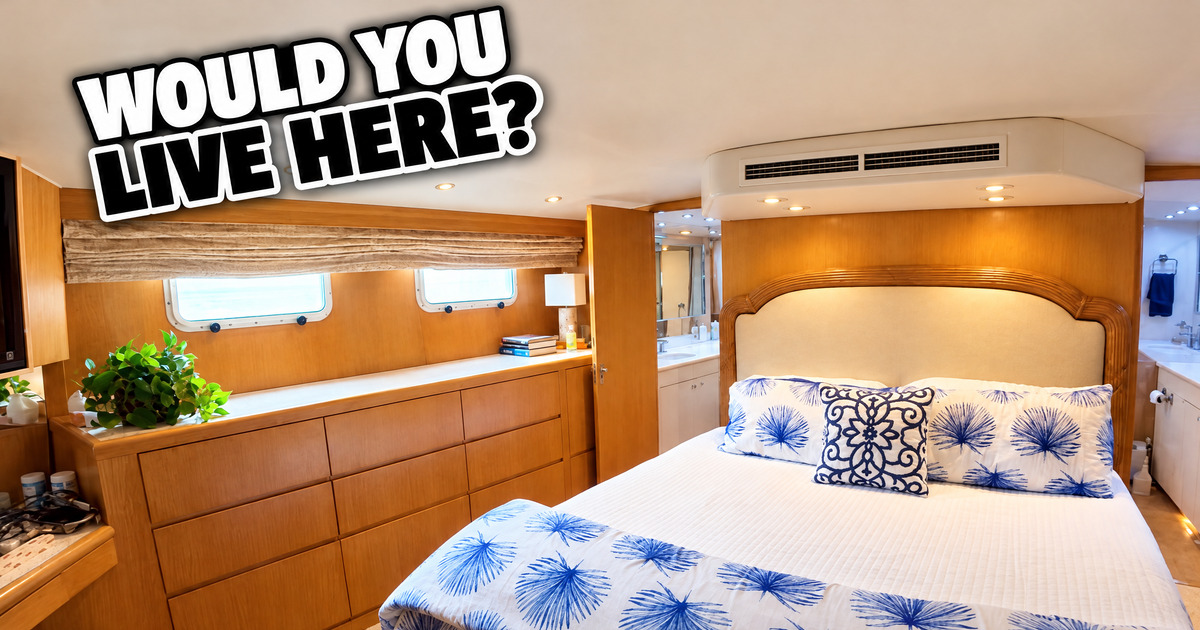
So we are in state room number three. This is the port side midship room or as we lovingly call it John and Tonya's room. They were the first couple who stayed in this boat and one of the couples that helped us bring the boat down from Wilmington. So this is John and Tonya's room, but this room just had the carpet replaced in it. New bedding. We have two full size lockers in here for hanging stuff, drawers. This is actually a really nice size state room, queenish size bed. And then they do have their own attached head. And those familiar with Hatteras know that they like to have bathtubs. So this does have a full size shower and bathtub in it. And it's not just a regular bathtub, but it is a jetted tub. So we are in the, we're still in the process of replacing LED lights with the proper ones that Hatteras likes to use. So we still have to replace the ones over the sink. But this is actually a really nice size state room with a joining head. Yeah. And originally, I don't think we really cared for this tile that much, but I will say over two and a half years, it's actually kind of grown on me to the point where I don't know if we'll replace it or not. I don't think we will. And one of the spectacular features of this room and one of my favorites is we have a walkthrough engine room so you can access it from both sides.
The Engine Room
And welcome to the engine room onboard empire. We have two Caterpillar 3412s. These are amazing engines. This was one of the primary reasons we bought the boat. They're slightly overpowered for this size boat, believe it or not. And at top speeds, we can go 31 miles an hour. As anybody will tell you, we don't we don't do that very often because the diesel consumption at that speed is astronomical. But about 30 seconds every time we come in, I like to run them up at full speed, get all the pressures high. You know, really let them breathe and clean out any suit that might be in there. So if we walk on in here, we'll do another video with a much more in depth walkthrough. This is by far the space that I spend the most time on the boat. I love this room. I love that the ceilings are so tall. You can access both sides of the motors. The access in here is absolutely phenomenal.
1,000-Hour Service & the Bow Thruster
We just recently completed our thousand hour maintenance. These motors have a little bit over 4,000 hours on them, which is awesome. This boat is almost 30 years old. What that tells me is somebody used it. It wasn't just a dock princess. So I wasn't too terribly concerned about hours. One of the other things that made me feel more comfortable about it is these motors can be re sleeved in the boat. So it will be beyond our ownership, but someday when these motors need to be completely overhauled, they can re sleeve them, which means that these motors should be in this boat the entire duration of this boat's lifetime. Well beyond my overall lifetime, if people continue to take care of it, this boat will last for tons and tons more decades. So right now we're just finishing up a major overhaul on our hydraulic bow thruster system. Other than the bow thruster motor, we've essentially replaced everything. Hoses took the extension tank off, redid it, and we're still working through an electrical issue that got damaged during a lightning storm. I will talk way more about that. It took us eight or nine months to get all the parts and software and everything else we needed. It was kind of a mess.
The Original Water Pump & Stabilizers
One thing I like to point out with the boat is our Mach 5 water pump. So that is original to the boat, 1998 model, and she worked like a charm. So you see the blue tank she's sitting on, the expansion tank. We did have some issues about, what I'd say like two months ago where the tank was just running and had like a horrible noise. And come to find out we just needed a new expansion tank. We actually talked about replacing the water pump, but at this point in her stage, if we do anything, we'll just buy one as a standby because she works great. Yeah, in fact, Trisha had dealt with them the most, but headhunter who makes that, we were in contact with one of their engineers and we were like, "Hey, should we just replace it or should we buy a repair kit to redo the impeller in there?" I was terribly impressed. I was ultra impressed with that company because he was super honest with us. He said, "If it's working right now, keep it until it dies. It's not worth at this point doing any maintenance on it. It still works great." And he said, "Don't waste your money on it. Just replace it at some point." Where he easily could have sold us a brand new water pump, which is what, $2,500? Yeah, $2,500. The impeller kit, I think, was just under $300 and he was like, "Save your money. I wouldn't mess with the impeller. Save your money to buy a new one." Okay. And one thing I didn't talk about upstairs is we have stabilizers, which keeps the boat stable when we're underway. We spend most of our time out in the ocean, so that's really important. I don't mind when a boat lifts as much as Trisha does. She really doesn't like it. It makes her feel uncomfortable. So we actually did a major overhaul and ours completely removed them, redid the shafts, redid everything on them. Our stabilizers are new at the moment. One thing James had one of our vendors add were these plexiglass covers over the stabilizer so that he can come down when he's doing his interim checks or when we're underway and he can just look in there and make sure that the stabilizers are working. So we actually have those on both sides.
Our Hourly Engine Room Checks
My philosophy for this boat in particular is we're really big on hourly engine room checks. I know a lot of people like to say they do it. We actually try to stick to it and do them just because if something goes wrong, there's usually early warning signs and by doing those hourly engine room checks, you just feel comfortable that everything is okay. With an older boat, things can go wrong. So we've been very fortunate in that we do a lot of maintenance on them. We do those checks. We really keep up with all the stuff and we've had really, really good luck with her and both of these motors have been fantastic. And Sean with coral reef diesel is the only diesel mechanic that touches these motors. I'm a big fan of kind of assigning the duty of maintaining these things to one mechanic. That way you don't have nine different mechanics with nine different ways of thinking about things doing things nine different ways. Our experience has been find a super awesome mechanic that is aligned with how you think. He happens to be OCD like I am with this room and helps us upkeep it. As Trisha said, we added 3/8-inch plastic glass plates over our stabilizer so without crossing the motors, without walking by water pumps and belts, you can just look over there and spend. One of our future projects in here is probably to do the whole engine room that way and I want to add LED lights underneath the bilges so that anytime, whether it's me, Trish or somebody else, doing those checks can walk in this room, stand in this aisle and know and see everything that they need to see in order to complete their hourly engine room check. I believe that's really important. The easier it is, the more likely that we're going to do it and I'm trying to make it as easy as possible and as safe as possible. As I said, we spend a lot of time in the ocean so crawling or walking past belts, anything that might catch you, your clothing, whatnot. I just don't want to do it. People get hurt that way and we don't really want to get hurt that way.
The Owner's Stateroom
Alright we are in the owner's state room. We just did a video on this so I'm not going to cover a whole lot but she is almost done. We've just got a couple small projects to do and then we did not show you guys our closet. Oh, I did not show my mess. Yes, this is your mess. So until I arrange this stuff and find a home for it, it's sort of my own personal hell in here. That's where we keep all of our tools and whatnot. But it is a really nice sized closet so one of James' chores before we move on the boat is he has to take care of his closet. So as we showed in the last video, we've done a lot of work in this room to get ready to move aboard. We've got a spa tub in here, a shower, which is really awesome. We're getting ready to replace that pump, which is the spa pump. Got another head on the other side, which is one of the features of this particular model. Some of them have two heads, some of them have an extra room. We ended up with the one that has two heads. And here in the next week or so, we're going to start replacing these hatches. It's kind of cheap, flimsy plastic. It's obviously lasted 30 years and been out in the ocean many, many times, but for safety reasons. And so that we can leave these open more often, we're going to put new thicker modern plexiglass in there that's tinted. So we can just leave the curtains up because we both like natural light.
What's Next: The Bahamas
Thank you for watching the tour of Empire today. We hope you guys like and subscribe and follow along as we move on the boat, take her on short trips up and down the East Coast and eventually take her to the Bahamas. Thanks guys.