A water pump can be perfectly visible and still be almost impossible to remove. Perhaps a fitting faces the wall. Perhaps the wiring stretches tight before the pump clears its bracket. You can see the problem. You just cannot get a tool onto it.
At Anchors to Axles, we connect life on the water with life on the road. One useful crossover is the engine-room approach to maintenance: plan around the next service job, not simply where the equipment fits on installation day.
Design for the tool, not just the part
Inspection access is not repair access. A small opening might reveal a pump’s identification plate while leaving no room to release a fitting or turn a screwdriver.
Work backward from the likely job. For a freshwater pump, can you clean the strainer and reach the connections? Can a driver line up with every mounting screw? Once disconnected, will the pump actually fit through the opening?
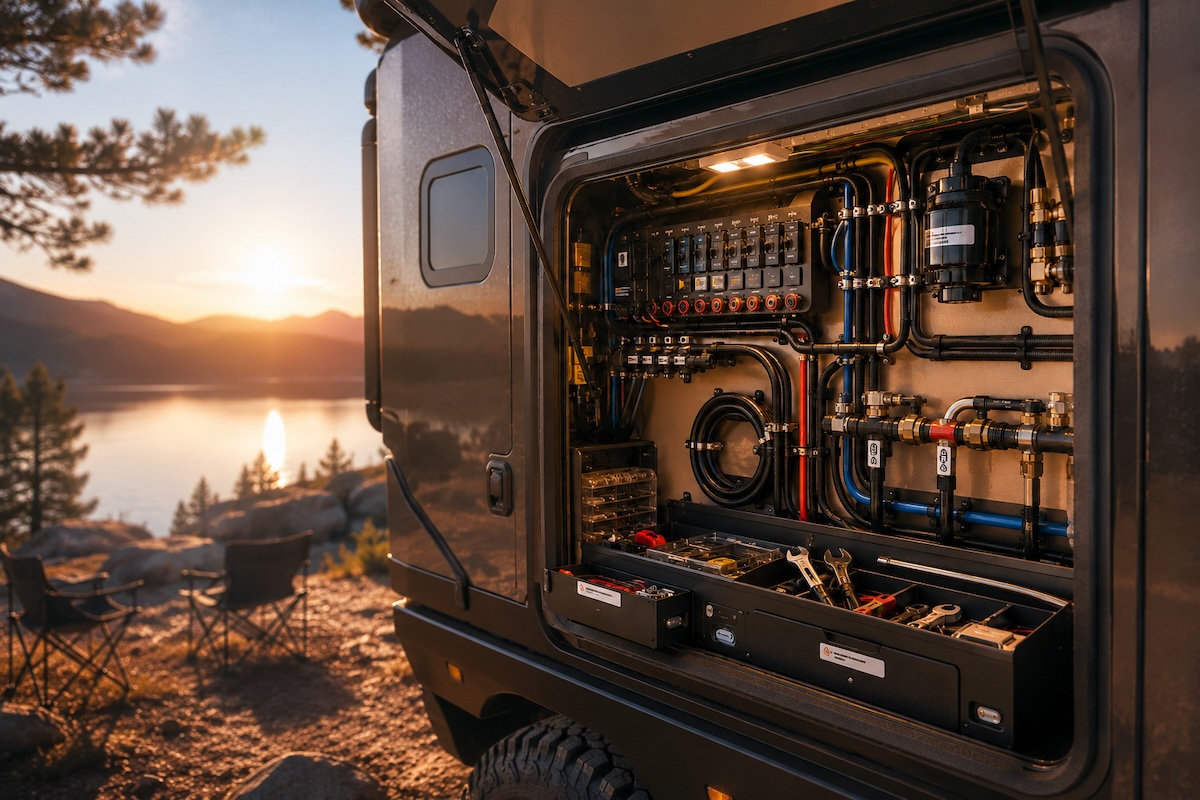
Leave room for the less glamorous necessities, too. A shallow tray beneath a water connection can keep residual water out of the compartment. A filter housing needs clearance in the direction it comes off, not merely a door facing it.
Where the enclosure allows it, a removable cover with reusable fasteners beats dismantling finished furniture. Keep that cover reachable after packing. Access behind a few loose items is inconvenient; access behind a permanently mounted battery box is a design conflict.
Before cutting, locate hidden utilities and confirm that the panel is nonstructural. Preserve required ventilation and protective barriers; alterations to propane or mains-voltage systems belong with a qualified RV technician.
Make service loops earn their space
A service loop is deliberate extra cable or suitable hose length that lets equipment move for maintenance without pulling on its connections.
A removable monitoring panel is a good example. Where the equipment permits, enough cable behind it allows the panel to come forward so you can reach its rear connections. Without that allowance, removing the screws leaves it hanging from the wiring.
More slack is not automatically better. Use enough for the intended movement, respecting the cable or hose manufacturer’s bend limits. Support fixed runs and provide strain relief so connectors do not carry the load. Keep the spare length clear of heat, sharp edges, and moving hardware.
For water hose, check that the bend stays open when the component returns to its installed position. A useful loop becomes a problem if closing the panel kinks it. Do not improvise loops in propane lines.
Before touching electrical connections, follow the system’s isolation procedure and verify power is off. Unplugging shore power alone does not make an RV electrically dead.
Label for the person troubleshooting after dark
That person may be you, with less patience than you had during installation.
A useful label answers a specific question: what is this, or where does it go? Keep the names consistent across the equipment and its documentation.
- Label accessible wiring at both ends, identifying its source or destination as appropriate.
- Match component names to the fuse-panel directory. “Freshwater pump, DC circuit 7” is useful only if circuit 7 carries the same name.
- Mark water shutoffs by what they isolate, rather than using an unexplained “Valve 2.”
- Put labels where they remain readable with the equipment installed.
Choose labels suited to the compartment’s heat and moisture. If you record fuse ratings, copy the specified rating for the circuit. A larger fuse is not a troubleshooting shortcut.
Keep a record before closing the panel
Take a wide photograph that shows the routing, then close-ups of connections and equipment identification. The wide shot helps locate things; the close-ups help identify them.
Save those images with the manual and replacement part numbers in an offline folder. Keep a printed circuit directory in the RV, too. A phone with a flat battery makes a poor filing cabinet.
Update the record after modifications. An accurate sketch is more useful than a polished diagram of wiring that no longer exists.
Try the repair position in the driveway
Choose one awkward component before the next trip. A pump or filter is a practical starting point.
With the system safely shut down, open the service area and try the tools the job would require. Check the fasteners and removal path. For plumbing, identify the relevant shutoff and depressurization procedure before loosening anything.
You do not have to disconnect a working component to discover that a screwdriver cannot reach its screws. That discovery is much cheaper in the driveway than during a travel day.
Fix the worst obstacle first. Better access can reduce the time a technician spends dismantling cabinetry before diagnosis even begins. Away from a shop, it can turn a mystery behind a wall into a fault you can inspect and explain.
Follow our Anchors to Axles journey for more practical connections between yacht and RV life, including the behind-the-scenes work that makes the next departure possible.