A bigger battery bank can buy another night off-grid. It cannot fix a failed main disconnect. That distinction matters when the furnace stops after dark and the nearest parts counter is tomorrow’s problem.
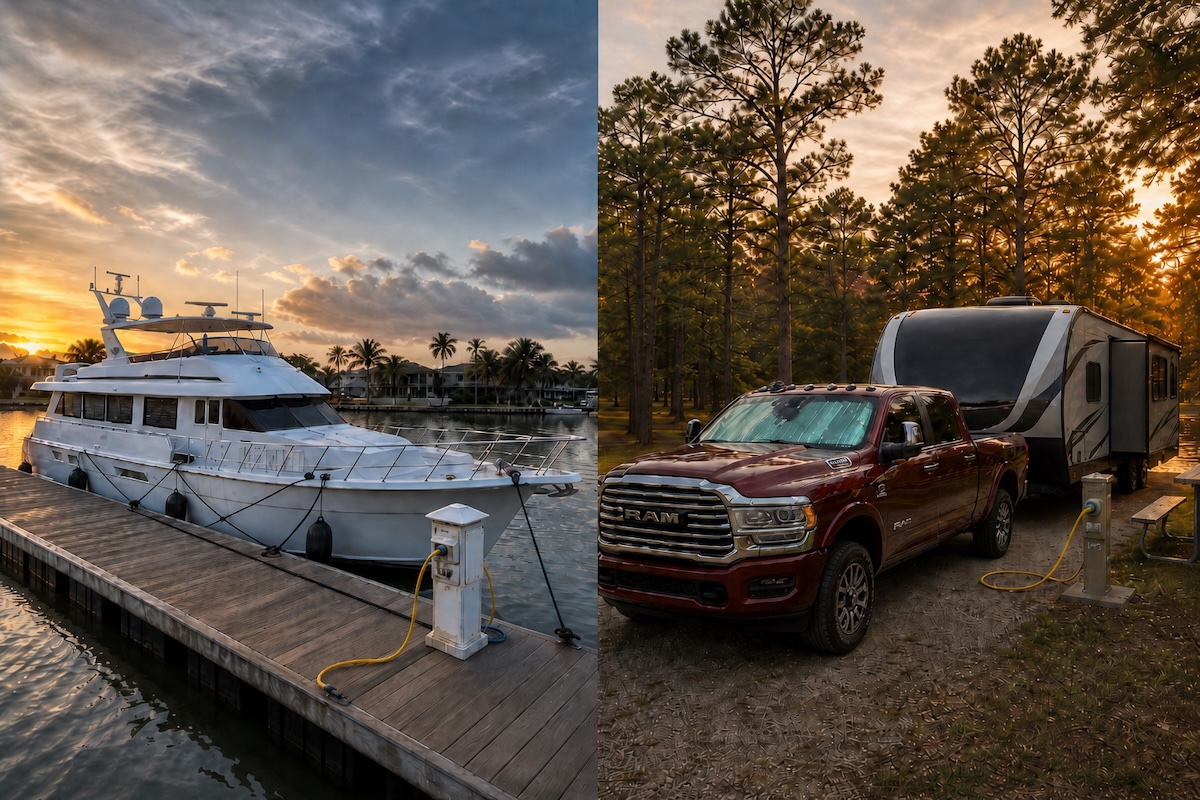
At Anchors to Axles, we connect life aboard the 74-foot Hatteras Empire with life on the road. The yacht-side lesson worth bringing to boondocking is simple: confidence comes from knowing what survives a failure, not counting how much equipment is installed.
More capacity is not the same as backup
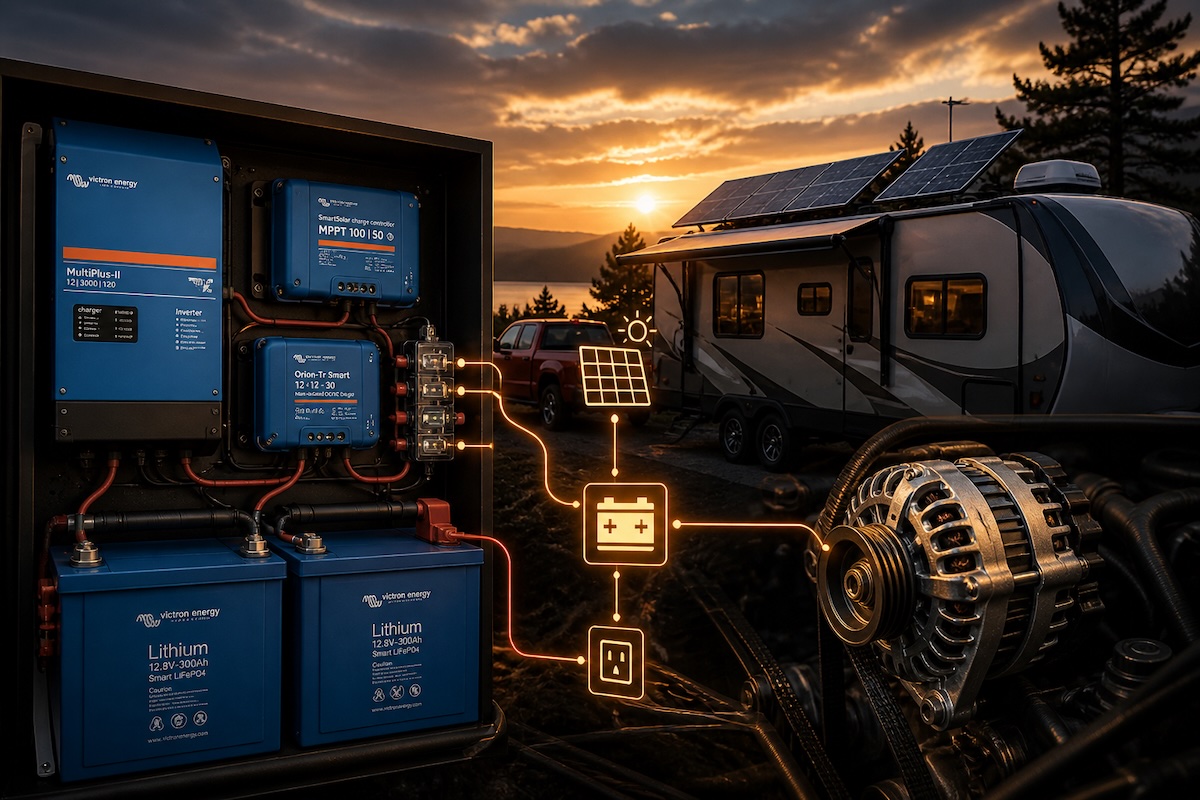
Two batteries wired in parallel usually form one larger bank. They add capacity, but they can still depend on the same main fuse or cable. A fault in the shared path can silence both.
Separately protected, disconnectable battery branches can provide useful redundancy, provided the remaining branch can safely carry the reduced load. That requires deliberate fault protection and switching, not simply another battery bolted beside the first.
Have a qualified RV electrical professional design the protection and isolation, accounting for current from every connected source. Batteries intended to operate in parallel need to meet the manufacturer’s compatibility requirements. Don’t improvise a mixed-chemistry backup connection.
Also check the single-bank limits. Losing half the capacity may be manageable; asking one lithium battery’s management system to support the inverter load previously shared by two may trip it immediately. Backup operation often means switching off the microwave, not continuing breakfast unchanged.
Make two charging paths genuinely useful
Solar and alternator charging offer useful variety. Solar can work while you’re parked in suitable sunlight; alternator charging can replenish the bank while traveling.
But separate energy sources do not necessarily mean separate charging hardware. Shore power and a generator may both feed the same onboard charger. A charger failure defeats both options.
Solar through its own controller plus alternator charging through a properly sized DC-to-DC charger provides more separation. Alternator output and the complete wiring circuit still have to support the intended load. For a towable RV, don’t assume the standard trailer connector can handle the charging current you want.
Trace both paths all the way to the batteries. If they converge at one failed disconnect or bus connection, both sources can be healthy while the batteries receive nothing. That shared point belongs on your troubleshooting map.
Make fault isolation obvious
Fault isolation means disconnecting the problem while preserving as much healthy equipment as possible. A backup system that requires a switchboard scavenger hunt is a poor companion after dark.
Keep the layout understandable:
- Label disconnects and charging-source controls so their purpose is clear without opening a manual.
- Keep engine-starting reserves separate from routine house loads.
- Give essential DC loads their own fused circuits rather than making everything depend on an inverter.
- Keep a simple diagram showing the charging paths and shared connections, with a documented isolation procedure.
Dedicated circuits help isolate individual load faults. They do not eliminate a shared main-feed failure, which is why the diagram matters as much as the labels.
Resist adding switches for every imaginable scenario. Each new operating mode creates another way to leave the system incorrectly configured. Aim for a few deliberate choices you can explain without pointing at six different compartments.
Define what backup power actually buys
A useful backup target is refrigeration and enough lighting to get through the night. Include a furnace blower if cold weather makes it essential. Work from actual energy use in watt-hours, then check that the remaining bank can supply the peak current.
If refrigeration requires AC, include the inverter in that survival plan. Healthy batteries will not rescue a failed inverter.
You may decide that a separate reserve battery adds too much switching and charging complexity. A well-protected main bank with two useful charging paths can be the better trade if your fallback is leaving camp rather than staying off-grid through a battery fault. The important part is knowing which failures your setup covers and which ones end the stay.
Rehearse before the remote campsite
At home, use only the system’s intended controls to test each charging path independently. Verify any documented single-bank mode under a modest load. Follow the component shutdown sequence; don’t pull live cables to simulate a failure.
Record which switches change position and which loads get turned off. Keep that procedure with the system diagram. If switching to backup requires guessing, simplify the design before depending on it.
The payoff is ordinary in the best possible way: fewer mysteries when something quits, and a clear decision about whether to stay or head out.
Follow along with us at Anchors to Axles as we document the systems and ownership lessons behind life afloat and off-grid.