A 50-amp hookup sounds like a modest step up from 30 amps. For a typical RV, it actually provides more than three times the available power. On a boat, that same “50 amp” label needs a closer look.
Knowing the difference helps you avoid overloaded connections and figure out whether air conditioning and breakfast can peacefully coexist. The pedestal gets a vote.
Why 50 amps can mean much more power
These examples cover common North American hookups. The useful calculation is simple:
Watts = volts × amps.
Amperage tells only part of the story. Voltage determines how much power that current can deliver.
| Service | Supply voltage | Total nominal capacity |
|---|---|---|
| Typical 30A RV or marine | 120V | 3,600 watts |
| 50A RV or 125/250V marine | 120/240V | 12,000 watts |
| 125V 50A marine | 120V | 6,000 watts |
The 125V and 125/250V markings are connector ratings; these calculations use nominal 120V and 240V supplies.
A common 50A, 120/240V service has two 120V hot legs, each capable of supplying 50A. That gives you 6,000 watts per leg, or 12,000 watts combined. There is also 240V available between the legs.
Most RV appliances run on 120V, with their circuits distributed between those legs. You can overload one leg even when total consumption is below 12,000 watts. The total matters, but so does where the loads land.
Boat and RV plugs are not interchangeable
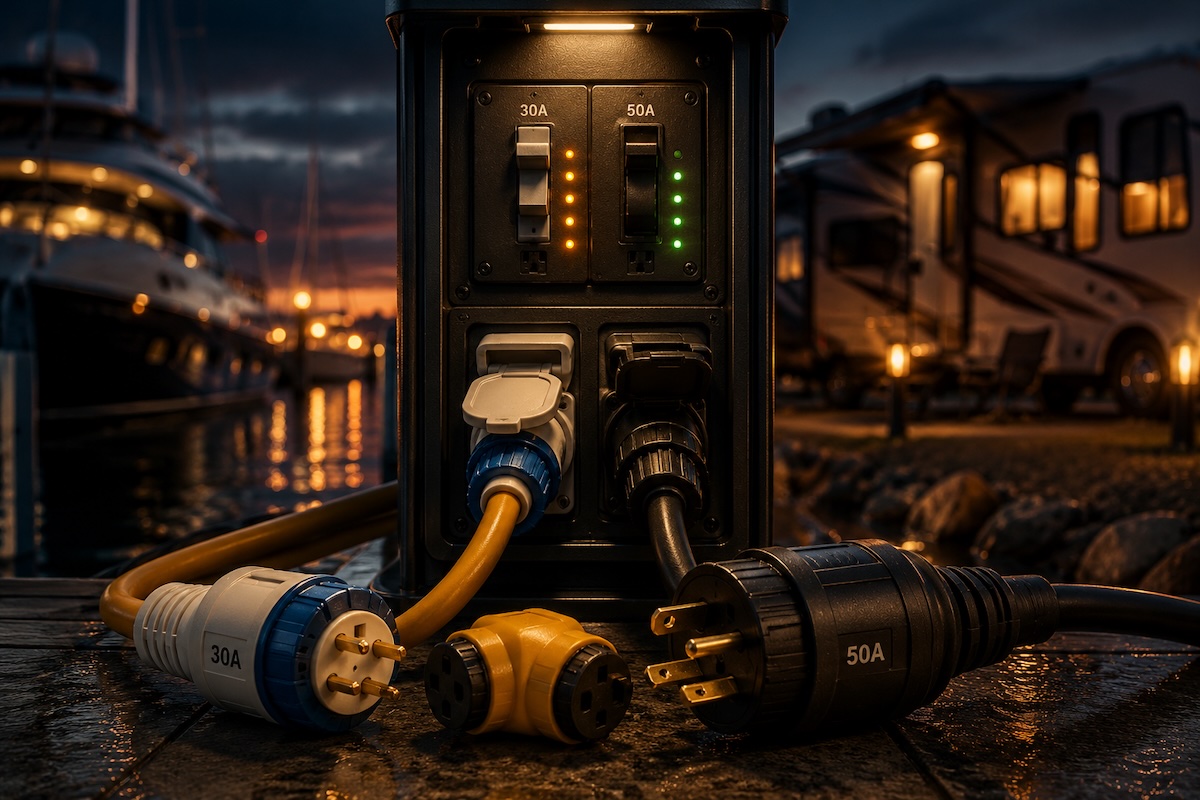
A 30A RV connection generally uses a TT-30 plug; a 50A RV connection typically uses a NEMA 14-50. Marine connections commonly use locking connectors, and marine 50A systems have distinct 125V and 125/250V versions.
Matching the amperage is not enough. Read the equipment inlet label and cord rating before choosing a hookup or adapter.
A 30A RV inlet expects 120V. Feeding it 240V can destroy equipment and create a fire hazard. A household dryer outlet is not automatically a suitable RV hookup, regardless of a familiar-looking plug.
If a boat has twin 30A inlets, check which loads each serves rather than treating them as one unrestricted 60A connection.
An adapter changes the connection, not the capacity
Use a purpose-built adapter intended for the equipment and service, with the protection its manufacturer specifies. For typical RV hookups, the practical limits are straightforward:
- A 50A RV on a 30A pedestal, connected through a suitable RV adapter, shares one 30A supply across the RV. It does not get 30A on each leg.
- A 30A RV on a 50A pedestal, connected through a suitable RV adapter, remains limited to 30A by its own main breaker. Its wiring has not become a 50A system.
Boat systems require a closer look. A simple adapter from a 120V supply cannot provide 240V for equipment that requires it. Check the boat’s electrical requirements before assuming that a plug which fits will power everything aboard.
What can you run on 30 amps?
Two 1,500-watt loads draw about 25A at 120V. On a 30A hookup, that leaves little room for everything else before reaching the service rating.
An electric water heater or battery charger can quietly consume that remaining capacity. Air conditioners also have startup demands that can trip a breaker even when their running load looks manageable.
Use appliance input ratings to build a realistic power budget. A microwave’s advertised cooking wattage, for example, is not its electrical input wattage.
On limited power, pause one large load before starting another. Turning off electric water heating while using the microwave can be more useful than another walk to the pedestal. On 50A service, there is more room, but each leg still has a limit.
A connection routine worth keeping
Inspect the plug and inlet for damage or discoloration. Loose contacts can overheat without immediately tripping a breaker. Keep connections dry and out of the water, and support the cord so its weight does not pull on the inlet.
Switch off major loads and the pedestal breaker before connecting. For a detachable cord, connect the boat or RV end first, then the pedestal end. Secure connectors as designed before turning the breaker on.
When disconnecting, switch off the loads and pedestal breaker, then unplug the pedestal end first.
If the supply voltage or outlet condition is uncertain, have the marina or campground operator check it rather than guessing. Stop using a connection that repeatedly trips, gets unusually hot, or smells burnt, and have it checked. Never bypass grounding or leakage protection to keep the power on.
Follow us at Anchors to Axles for more practical looks at the boat and RV systems that keep the adventure running.