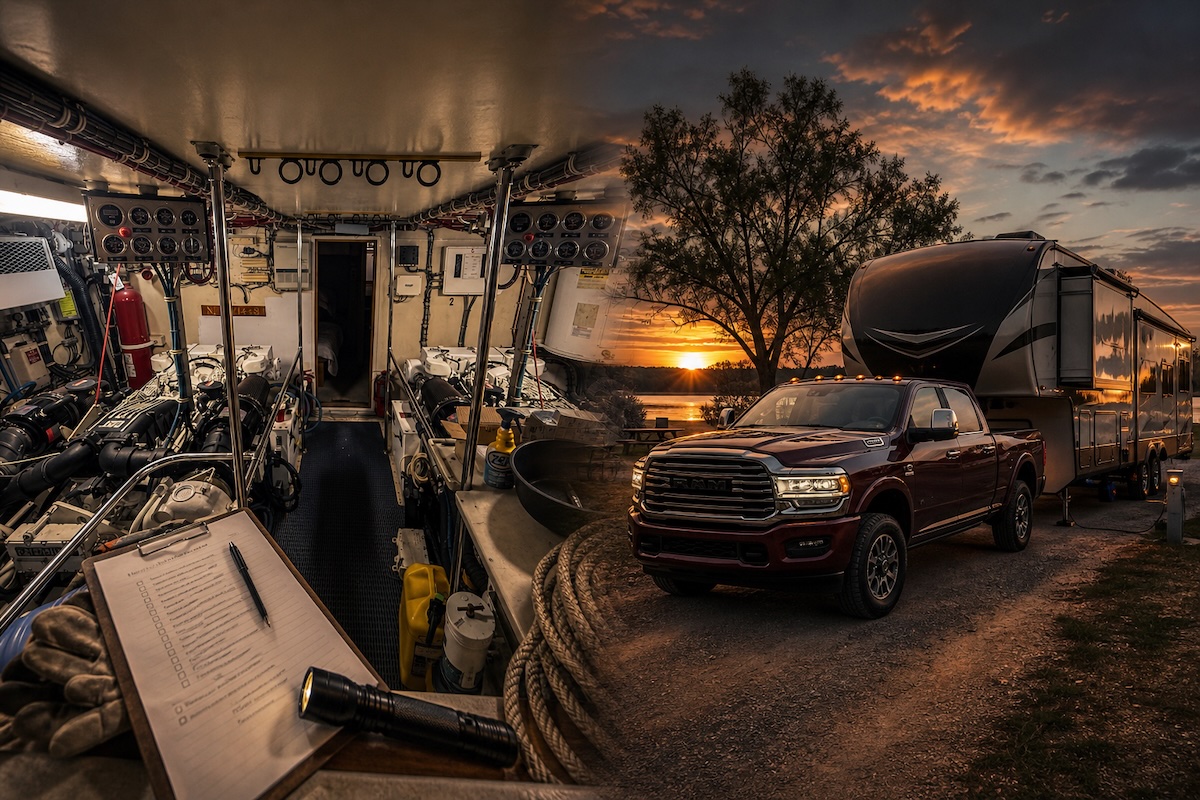
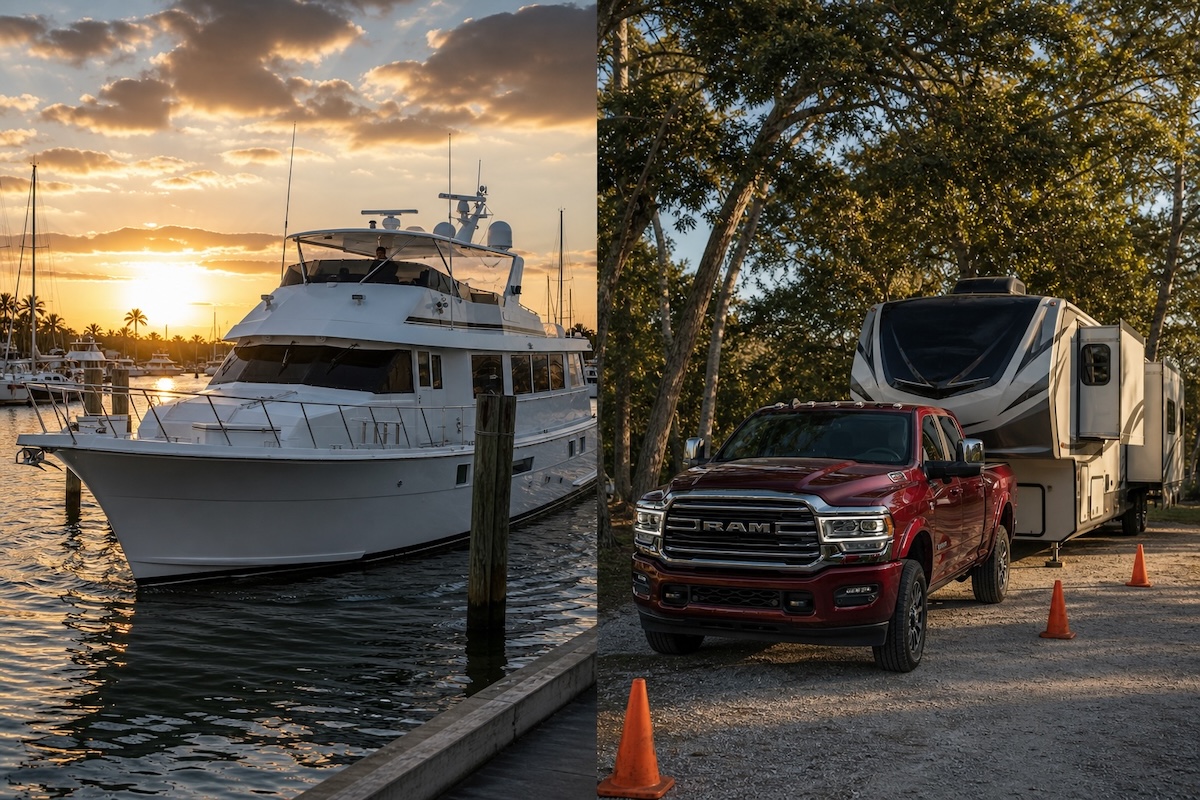
The most useful crossover between yacht docking and trailer backing happens before anything touches anything. It is recognizing a bad approach early, while there is still room to fix it. Gelcoat and bumpers are expensive ways to discover you waited too long.
The controls do not transfer directly. A yacht has momentum and windage; a trailer pivots around a hitch. What carries over is the habit of watching how the maneuver is developing, rather than waiting for something to look obviously wrong.
Here is how to practice that habit without making your campsite neighbors part of the experiment.
Read the approach, not just the parking space
A campsite can comfortably fit your trailer and still offer a miserable approach. The tow vehicle’s front end needs room to swing. The trailer’s rear overhang can sweep outside the path of its wheels. That innocent-looking utility pedestal deserves your attention.
Walk the route before backing. Look overhead as well as along the ground, and identify anything that will disappear from your mirrors.
The docking equivalent is studying more than the slip. Where is the wind pushing the bow? How much room remains if the current carries you sideways? A destination can be suitable while the approach is not.
Choose a check point before moving. If a critical obstacle disappears from view, stop, secure the rig, and get out to look. An obstacle you cannot see has not become less solid.
Watch the angle before it becomes a problem
When docking, the gap between hull and dock tells only part of the story. How quickly that gap is closing matters just as much. Watching relative movement gives you a chance to act while the correction is still small.
Apply that thinking to the angle between your trailer and tow vehicle. Check both mirrors. Is the angle holding steady, or becoming sharper with every foot you reverse?
A steering input starts changing the trailer’s direction. Leaving that input in place can keep increasing the angle. As the trailer turns toward the space, the tow vehicle has to come back into alignment behind its path.
Make a small adjustment, move a short distance, and read the result. If the angle keeps growing despite your correction, stop and pull forward along a clear path to straighten the combination. The campsite does not award extra points for doing it in one shot.
Move slowly enough to understand what is happening
On level ground, practice trailer backing at walking pace or slower. Use a full stop whenever you want time to assess the position. The brake pedal is a useful thinking tool.
A yacht does not offer that luxury. Neutral removes thrust, not momentum, and simply drifting more slowly can leave you with less control in wind or current. The useful target is a low speed that still preserves control for that boat and those conditions.
The shared lesson is to avoid outrunning your own understanding. If you are making corrections faster than you can judge their effects, create time and space rather than adding more frantic inputs.
Make communication boring and predictable
Agree on signals before the maneuver. One person gives directions; anyone can call for a stop. A vague wave is not a shared language.
For trailer backing, keep the spotter outside the vehicle’s path and swing area, never between the trailer and an obstacle. They stay where the driver can see them. If the driver loses sight of the spotter, the rig stops.
Aboard a yacht, agree on an abort signal and escape route before approaching. A shouted “stop” cannot cancel momentum. Rig fenders beforehand, and keep hands and feet out of the gap between hull and dock.
The reset belongs in the original plan. If the yacht’s approach leaves no safe way to back out or go around, reconsider it before committing. Pulling away early is much easier than improvising beside someone else’s paintwork.
A useful half-hour with a trailer and some cones
Choose a spacious, level area where you have permission to practice, clear of traffic and pedestrians. Use soft cones, with generous clearance around the rig.
- Begin with the tow vehicle and trailer aligned. Back through a wide cone lane, aiming to notice small changes in alignment rather than chasing perfect centering.
- From a straight start, make one small steering input. Reverse a few feet and stop. Observe the angle, then practice bringing the combination back toward straight with short movements.
- Create a broad, shallow-angle parking space. Practice entering it, then deliberately pull forward and reset. Learn what a useful reset looks like before you desperately need one.
- Add a spotter and repeat using your agreed signals. Test the stop signal while everything is still easy.
If you also practice afloat, learn low-speed response in open, clear water under manageable conditions, not beside a neighboring hull. With an unfamiliar boat, bring a qualified instructor.
Measure progress by how early you spot a developing problem. Fewer dramatic corrections are worth more than one lucky parking job.
Follow our journey at Anchors to Axles for more practical connections between yacht life and RV travel.