A fuel dock and a truck stop can deliver the same rude surprise: a total that makes you reconsider how much throttle you really needed. Still, saving a few gallons is a poor bargain if it turns a comfortable passage into a miserable slog or leaves a tow rig struggling in the wrong gear.
At Anchors to Axles, we connect life aboard the 74-foot Hatteras Empire with adventure on the road. Fuel economy belongs alongside the maintenance and planning that make both possible. These five tactics are worth testing against your own setup, with a few clear points where chasing savings stops making sense.
Measure fuel per mile, not just fuel per hour. On twins, divide the engines’ combined gallons per hour by GPS speed in knots to get gallons per nautical mile. For towing, verify dashboard MPG with fill-up calculations across several tanks. Compare similar loads and conditions.
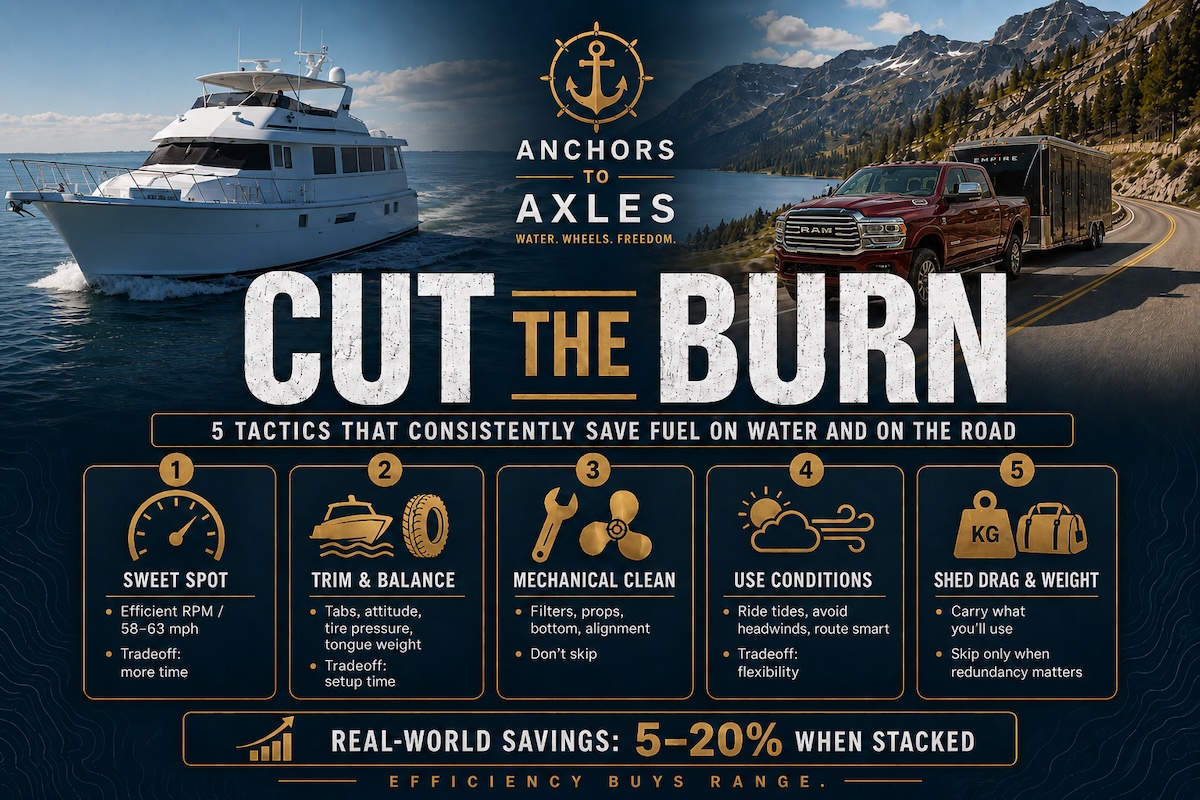
1. Find the efficient speed, not the lowest RPM
On many planing boats, displacement-speed cruising can be economical, while running bow-high between displacement speed and a clean plane can be a thirsty compromise. Actual fuel-per-mile readings tell you more than the tachometers alone. Check the engine maker’s guidance before making prolonged low-load running your default.
Towing, a modest reduction in highway speed cuts aerodynamic drag. Keep the pace appropriate for traffic and conditions rather than treating a particular speed as a magic number.
The price is time. Slowing down loses its appeal if it costs a safe weather window or pushes an unfamiliar arrival past daylight. Choose a workable arrival time first, then see how much room you have to ease back.
2. Stop paying to fight the conditions
A fair current can move a boat farther over the ground for the same engine effort. Favorable sea conditions may also let you hold a comfortable cruise instead of repeatedly backing off and accelerating. But the strongest current is not automatically the best departure window: wind opposing current can create rough water, particularly around inlets.
On the road, strong headwinds and repeated climbing can make a towing day thirsty. A different departure window may help if your schedule allows it. A longer route only pays if avoiding those conditions outweighs the extra miles and stops.
Waiting a whole day or adding a big detour for a small possible saving can cost more than it returns. Safe conditions remain the deciding factor.
3. Reduce drag without spoiling the setup
Before shopping for efficiency accessories, look at what is already moving through the air or water.
- On a boat with trim tabs, make small adjustments and compare fuel per mile once speed settles. More tab is not automatically better; excessive tab adds drag.
- On a tow rig, remove unused roof-mounted equipment when practical. Keep cargo secured and maintain the manufacturer’s specified tongue or pin weight and axle limits.
Dead weight is worth reviewing, but a few pounds of groceries rarely explain a painful fuel bill. Keep the water and emergency equipment the trip requires. Stripping out essentials to save a little weight is a lousy trade, and changing weight distribution carelessly can make towing unstable.
4. Use steady inputs and skip unnecessary idling
Looking farther ahead helps avoid paying to accelerate toward the next brake application. On suitable roads, cruise control can steady the pace; on rolling terrain, watch for repeated downshifts. Use tow/haul mode, if fitted, as directed rather than forcing a high gear simply to keep RPM low.
A stable cruise also makes boat fuel comparisons more meaningful. Let readings settle instead of chasing every flicker of the speed display. Around docks or in close traffic, use whatever throttle safe control requires. Nobody wins a fuel-economy contest during a docking maneuver.
Cut out waiting-around idling where practical, not the warm-up or cooldown your equipment specifies. Those procedures serve a different purpose from running an engine because nobody has switched it off yet.
5. Recover the efficiency maintenance can restore
Marine growth on the hull and running gear adds resistance. Fouled or damaged propellers can hurt performance, too. If familiar RPM produces less speed under comparable conditions, investigate the change before feeding it more throttle.
For towing, set cold tire pressures using the applicable manufacturer guidance for the load, not a guess or an automatic move to the sidewall maximum. A dragging brake or failing bearing is a fault to fix, not something to tolerate while experimenting with MPG.
There is a spending limit here. Discretionary cleaning solely to chase a tiny fuel saving may not justify its cost. A suspected mechanical fault deserves attention regardless of the fuel calculation.
Change one variable at a time and keep notes. Keep the changes that deliver repeatable savings without compromising safe operation or making the trip worse.
Follow Anchors to Axles for more on the route decisions and systems upkeep behind travel by sea and road.