A warm refrigerator is a lousy reward for finding the perfect anchorage or campsite. The fix isn’t automatically more solar or a bigger battery. Start with what you use each day, then choose a way to replace that energy that fits how you travel.
Count watt-hours, not appliances
Watts tell you how much power something draws while running. Watt-hours tell you how much energy it uses over time. Multiply watts by hours of actual operation to build your daily budget.
Here’s a hypothetical day without air conditioning or electric space heating:
| Load | Power and daily runtime | Daily energy |
|---|---|---|
| Refrigerator | 50 W for 10 compressor-running hours | 500 Wh |
| Lights and fans | 40 W for 5 hours | 200 Wh |
| Laptop | 100 W for 4 hours | 400 Wh |
| Electric cooking | 1,500 W for 12 minutes | 300 Wh |
| Other small loads | Combined allowance | 200 Wh |
This totals 1,600 Wh. Rounding to 2,000 Wh, or 2 kWh, leaves a preliminary allowance for conversion losses and overlooked loads. Measure your own equipment with a plug-in meter or battery monitor; refrigerator runtime changes considerably with heat.
Air conditioning deserves a separate calculation. An air conditioner drawing 1,000 watts for six hours consumes 6 kWh by itself. No amount of optimism makes that fit a 2-kWh budget.
Size the battery for time between charges
At 2 kWh daily, two days without charging calls for 4 kWh of usable storage before adding extra reserve.
With an assumed 80% usable fraction, a 12.8-volt, 200-Ah lithium bank provides about one day’s energy in this example; 400 Ah provides about two. Lead-acid generally requires more nominal capacity for comparable usable energy.
Don’t compare batteries by amp-hours alone. A 200-Ah bank at 24 volts stores twice the nominal energy of one at 12 volts.
The inverter has a different job. Size it for simultaneous AC loads and startup surges. A 1,500-watt appliance isn’t a sensible match for a 1,500-watt inverter if other AC loads will run too.
Choose charging that fits your travel
Solar for quiet daily charging
Solar earns its space during stationary stays, provided it gets unobstructed sun. Boats contend with shadows from equipment or rigging; RV roofs lose useful panel space to vents and air conditioners.
For illustration, 800 watts of panels × four peak-sun-hours × a 75% planning factor yields about 2.4 kWh daily. Peak-sun-hours mean equivalent full-strength sunlight, not daylight hours.
That covers the example day with little left to refill a depleted bank. Use local seasonal sunlight estimates, allowing for shading and system losses. A cloudy winter anchorage won’t deliver summer-desert output.
Alternator charging for travel days
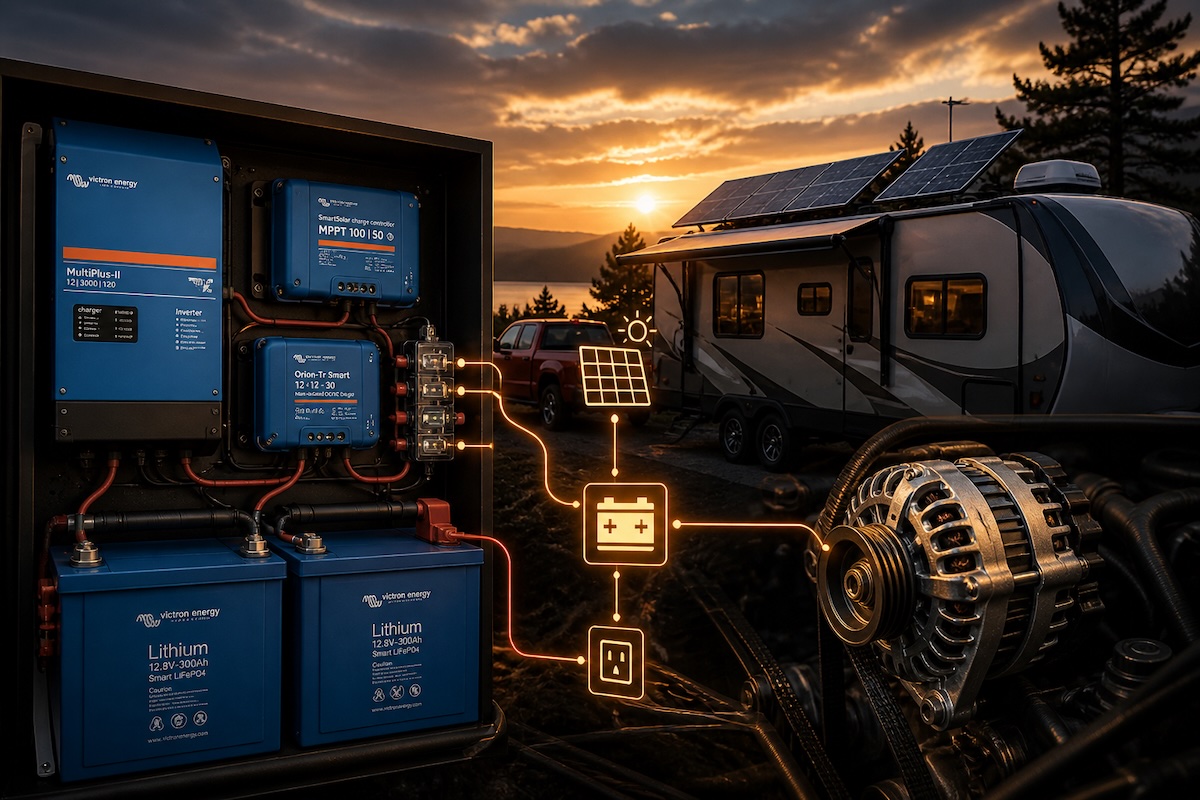
Driving or motoring can replenish batteries while you’re already going somewhere. A charger delivering 40 amps at about 14 volts supplies roughly 1.1 kWh over two hours, before losses.
But an alternator’s nameplate rating isn’t guaranteed continuous charging output, especially at idle. A parked rig gets nothing from it unless the engine runs.
A compatible DC-to-DC charger or properly engineered marine regulator setup helps control charging current. Lithium batteries can demand enough current to overheat an inadequately protected alternator, so this isn’t simply a matter of connecting a bigger battery.
A generator for heavy loads and weather gaps
A generator becomes easier to justify when air conditioning is part of the plan or cloudy weather outlasts your battery reserve. The trade-off is noise, plus fuel and maintenance.
Match continuous output to the battery charger and equipment running alongside it, accounting for startup demands. A big generator feeding a small charger won’t magically refill batteries faster.
Use a properly installed marine generator aboard a boat. RV portable generators belong outdoors, well away from occupied spaces and openings, with exhaust directed away. Keep working carbon monoxide alarms in either setup.
Do you need all three?
Not automatically. Choose around the days you’ll actually have:
- Long stationary stays favor solar, with enough storage for overnight use and a cloudy-weather backup plan.
- Frequent driving or motoring makes alternator charging useful; solar helps between moves.
- Heavy AC loads or extended poor weather make a generator easier to justify.
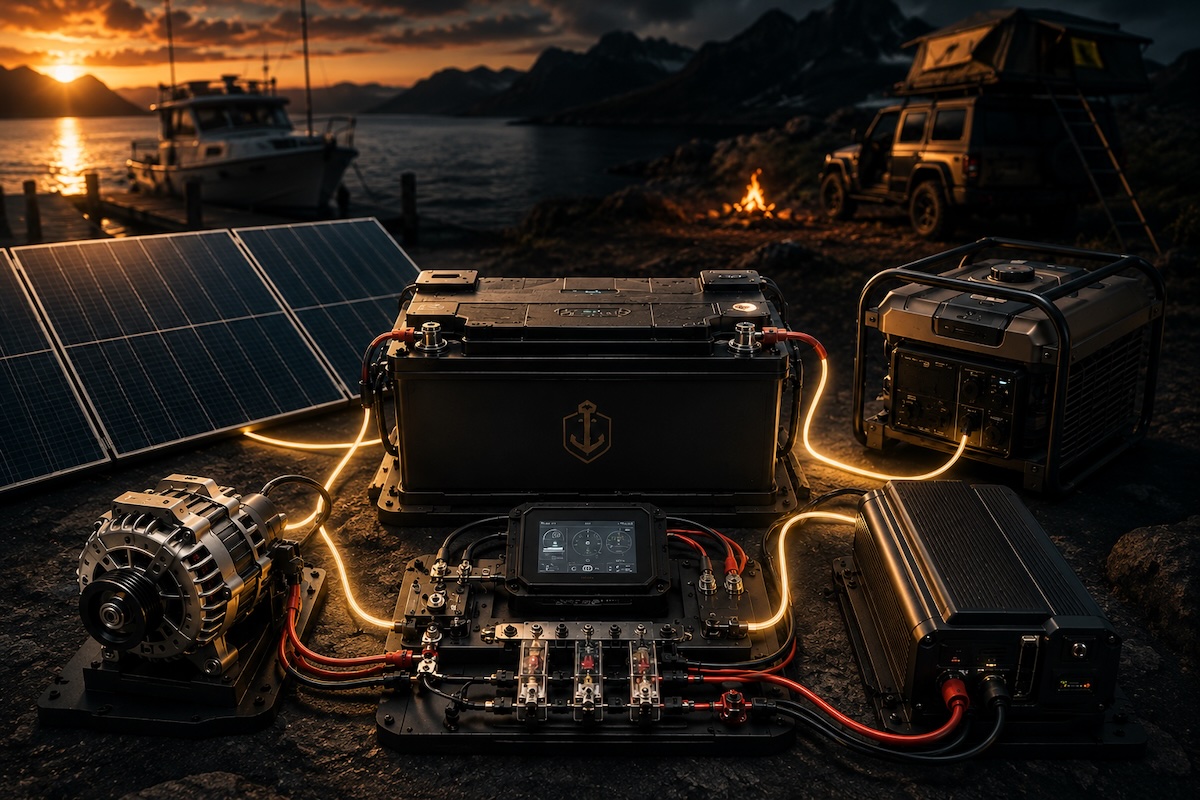
All three can be worthwhile, but each should earn its space and upkeep. More charging equipment doesn’t fix an undersized battery bank, and more batteries only postpone the problem if you can’t recharge them.
Before installation, have a qualified marine or RV electrician review charging compatibility and electrical protection. Wire sizes and fuses have to suit the installation. Battery charging limits, including temperature restrictions, matter too.
At Anchors to Axles, we document the upkeep behind life on the water and the road. Follow our journey for more practical discussion of off-grid systems and the ownership decisions behind the adventure.