A hookup can look perfectly ordinary until the microwave joins the air conditioner and everything goes dark. That might be a straightforward overload. A hot connector or current leaking into marina water is a different category of problem.
Shore power and campground hookups share electrical fundamentals, but their connectors and protection systems aren’t automatically interchangeable. The useful starting point is knowing what the pedestal supplies and what your equipment can safely accept.
Same amperage doesn’t mean the same hookup
These examples cover common North American services. Read the labels; marina installations in particular vary.
| Hookup | Typical supply | Nominal capacity |
|---|---|---|
| Marine 30-amp | 120V | About 3,600 watts |
| RV 30-amp, typically TT-30 | 120V | About 3,600 watts |
| Standard RV 50-amp | 120/240V | About 12,000 watts |
| Marine 50-amp | 120V or 120/240V, depending on service | About 6,000 or 12,000 watts |
Standard 50-amp RV service provides 50 amps on each of two 120-volt legs. That’s why it offers much more than a modest increase over 30 amps. Most RV appliances still use 120 volts, and each leg has its own limit.
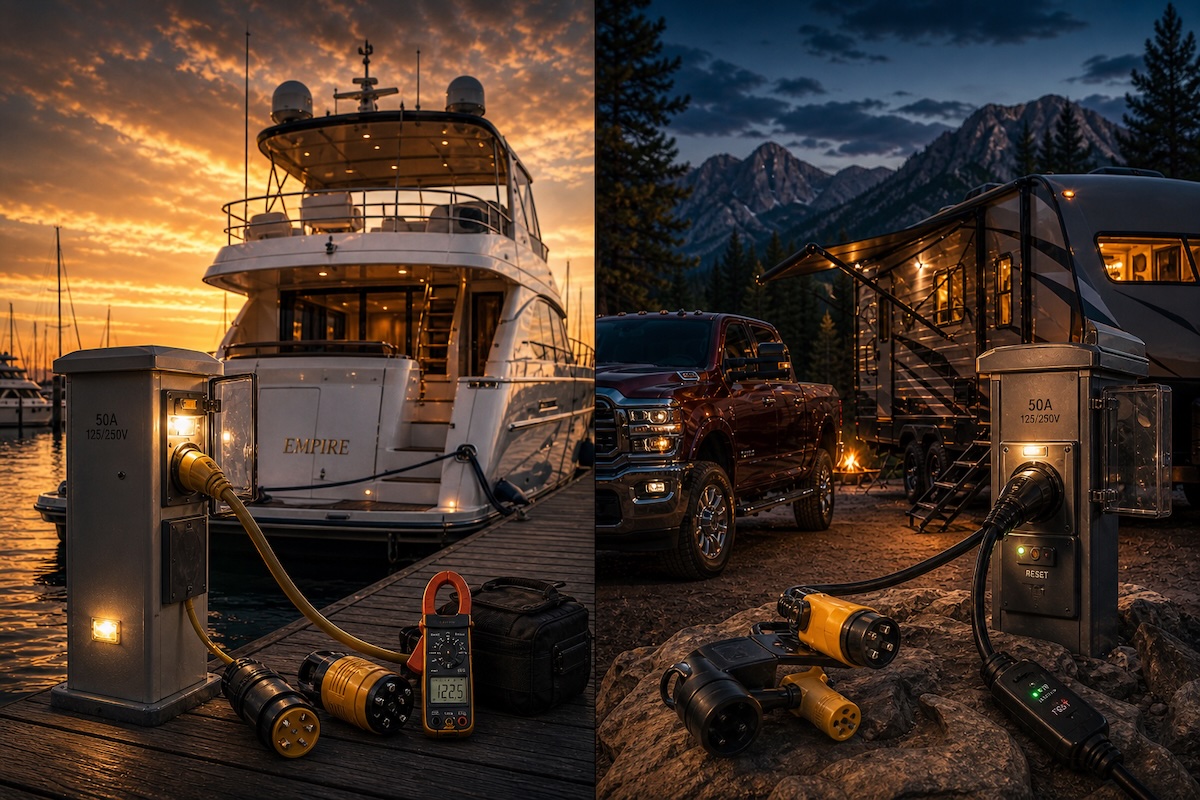
Marine 50-amp connectors may be marked 125V or 125/250V. Those are distinct configurations, not interchangeable options.
Also worth making explicit: a 30-amp RV connection is 120V, not a 240V dryer hookup. Plug resemblance is not an electrical specification.
An adapter isn’t extra power
An ordinary plug adapter changes the connection. It doesn’t increase available amperage or convert voltage.
Connect a 50-amp RV to a 30-amp supply using the correct adapter, and the entire rig shares that 30-amp allowance. You don’t get 30 amps per leg. Equipment requiring 240 volts won’t receive it from that 120-volt supply.
In the other direction, a higher-rated pedestal doesn’t upgrade a smaller cord or inlet. Use a listed adapter intended for the exact connection, with suitable overcurrent protection for the lower-rated equipment.
Marine connections also rely on their intended locking and weather-sealing arrangements. A chain of household adapters isn’t a substitute for the correct shore-power assembly.
Manage loads before the breaker does
On a 30-amp, 120-volt hookup, a 1,500-watt electric heater draws about 12.5 amps. Add air conditioning and battery charging, and the microwave may become the final straw.
Use appliance input ratings, not microwave cooking-output wattage, when estimating demand. Allow for motor startup surges and observe equipment continuous-load limits.
If your charger has an adjustable shore-power draw, reducing it can leave room for other loads. Slower charging is usually less annoying than another midnight walk to the pedestal. On split-phase 50-amp service, one leg can overload even when total consumption looks reasonable.
Low voltage matters, too. Long or undersized cords and poor connections can contribute to voltage drop. A surge-only protector doesn’t necessarily disconnect during sustained low voltage. Check the device’s actual protections and suitability for marine or RV use.
Connect with the power off
Turn off the pedestal breaker and the boat or RV’s shore-power main before connecting. Inspect the cord ends and inlet. Stop if you find melting or discoloration, significant corrosion, or a loose fit.
For a detachable shore cord, connect the boat or RV end first, then the pedestal end, with the supply still off. Secure connections as designed and keep them out of standing water. Verify the supply with appropriate testing or monitoring equipment before bringing loads online.
When disconnecting, turn off the onboard main and pedestal breaker, then unplug the pedestal end first.
Check for unusual connector heat or an electrical smell once loads are running. A poor contact can overheat without drawing enough current to trip an overload breaker. Shut down and investigate rather than accepting a hot plug as normal.
Ground-fault trips aren’t requests for a bigger breaker
Overload protection responds to excessive current. Ground-fault protection detects current escaping its intended path. Dock ground-fault protection and household-style GFCIs can have different trip thresholds and roles; neither substitutes for the other.
Moisture or damaged heating elements can cause leakage. Incorrect neutral-to-ground connections can also trip protection, sometimes involving inverter or generator switching. A different pedestal may expose an existing onboard fault rather than cause one.
If ground-fault protection trips, don’t keep resetting it. Disconnect shore power safely and have qualified personnel investigate the onboard installation and pedestal as needed.
Never defeat a ground connection or bypass protective devices. Neutral-to-ground bonding belongs in a qualified technician’s diagnosis, not an improvised adapter. At a marina, leakage can endanger people in the water. Don’t swim around powered docks.
At Anchors to Axles, we document the work behind yacht and RV life, including life aboard our 74-foot Hatteras, Empire. Follow along for more practical systems lessons from both sides of the pedestal.